Project
Italy's largest digital cultural project starts in in Milan's urban peripheries thanks to the NRRP fund for the Digital Transition of Cultural and Creative Organizations
Carlo Perini Foundation, active since 1962 as a cultural and social reference point for the Milanese peripheries, has realised the largest and most ambitious digital project in Italy for the digital transition of culture. All within the framework of the NRRP (National Recovery and Resilience Plan), Mission 1 – Digitalisation, Innovation, Competitiveness and Culture. The project, called ‘The City’s Alternative Story‘, exploits the Foundation’s large archive and specialised library holdings through advanced technological tools to enhance the historical, cultural and artistic heritage of Milan’s urban suburbs.
An immersive narrative exploring the historical and urban transformation of Milan's suburbs
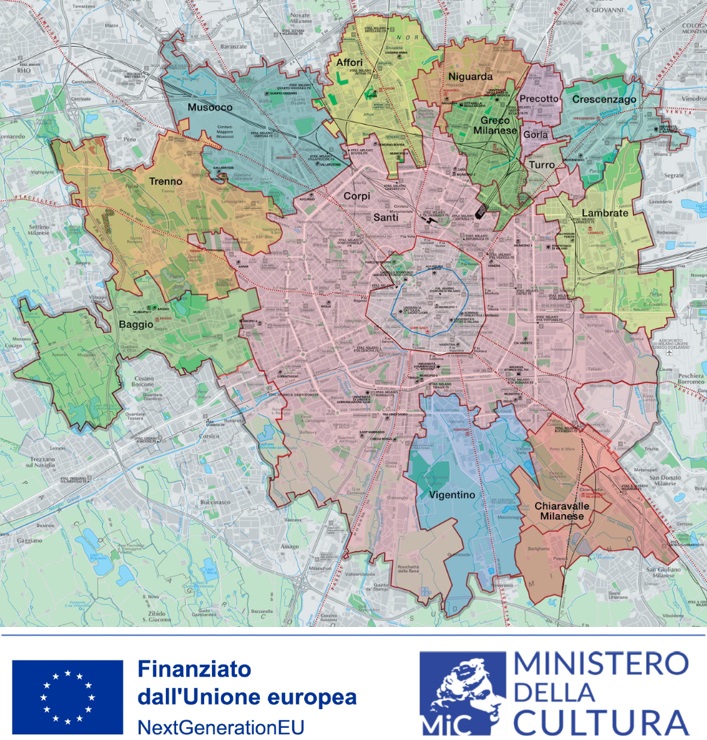
The heart of the project, accessible from this website, is a multidevice and multiplatform Web App, which makes interactive content available to the public. This digital tool, based on open standards and curated by Dr Marco Stucchi, offers an immersive narrative exploring the historical and urban transformation of Milan’s suburbs, in the wake of the celebrations of the birth of the ‘Greater Milan’ following the aggregation of 12 ancient municipalities more than a hundred years ago: Affori, Baggio, Chiaravalle Milanese, Crescenzago, Gorla-Precotto, Greco Milanese, Lambrate, Musocco, Niguarda, Trenno, Turro, Vigentino.
By means of interactive maps, high-definition gigapixel and spherical images, historical photographic documentation, multilingual textual content and narrative podcasts, the platform makes it possible to rediscover the symbolic places of these often forgotten areas, making them accessible online and stimulating live knowledge.
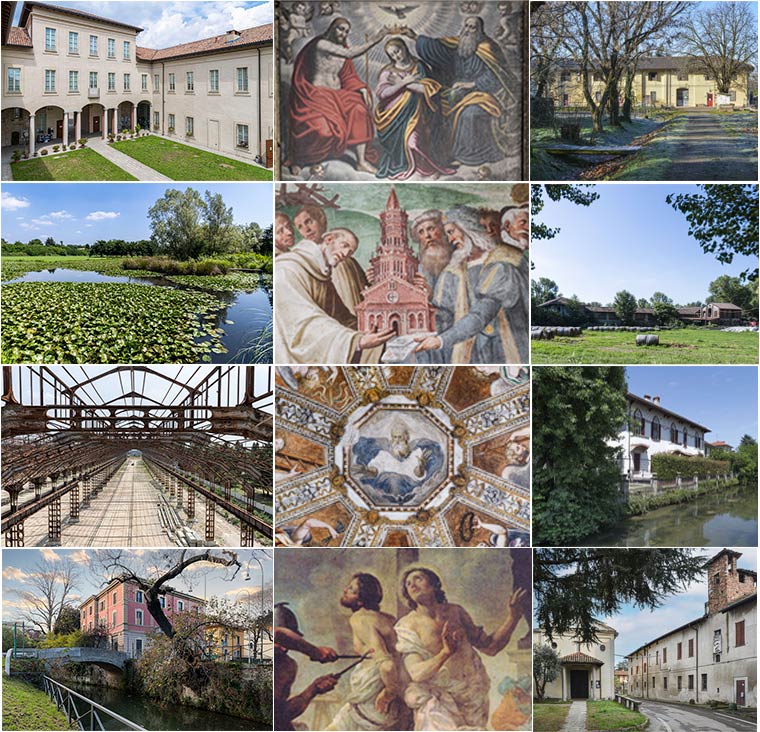
An alternative narrative of Milan that fits fully into a well-established vision of a polycentric city. Sixty landmarks of the old municipalities identified by the Foundation’s project team offer a unique immersive experience and will make Milan’s urban suburbs an attractive destination by expanding the city’s cultural offer. Churches, farmsteads, monuments, parks, villas and elements of industrial archaeology for an integrated design vision that represents a unique example of cultural and social regeneration.
The initiative aims to promote the areas of interest in order to:
- Enhance the historical and artistic heritage of urban peripheries, highlighting their cultural relevance and restoring their centrality in the city context.
- Promote social inclusion, with attention to the most fragile groups, such as people with visual and hearing impairments, through accessible digital tools (podcasts, subtitles).
- Strengthen the sense of belonging and collective memory, stimulating citizens to rediscover the historical roots and cultural identities of their neighbourhoods.
- Promote sustainability and environmental education, through cycle-pedestrian routes and activities that raise awareness about land stewardship and ecological transition.
- Extend international reach, preparing language broadening to reach a global audience.
The digital platform stands out for its innovative and educational character that includes:
An interactive map that subdivides the city of Milan into its ancient municipalities, allowing the most significant places to be explored virtually through multimedia content and immersive 360° images.
High-quality visual content, including digitised historical images and contemporary photographs in high definition, useful for enhancing architectural and artistic heritage.
Multilingual narrative documentaries that tell the story and evolution of the ancient Milanese municipalities that are now an integral part of the city.
Podcasts and explanatory cards, to facilitate inclusive access also for people with disabilities.
Guided and customisable itineraries to discover the suburbs through walking and cycling routes, combining history, culture and sustainability.
The project aims to reduce territorial inequalities, transforming urban suburbs from marginal places into attractive and cultural poles. The regeneration of these areas, in fact, is not limited to aesthetic enhancement, but aims to strengthen social cohesion, promoting dialogue and collaboration between institutions, associations and citizens. Thanks to digitisation and the use of innovative multimedia tools, the project stands as a replicable model for other urban realities, representing Milan’s suburbs as a ‘widespread heritage’ of international relevance.
A further distinctive aspect of the project is its educational value. Schools, universities and researchers will have at their disposal advanced tools to deepen the study of Milan’s suburbs, offering young people an interactive and engaging way of learning. Digital education, understood as an innovative approach integrating technology and active participation, will make knowledge of the territory more accessible and stimulating, encouraging the involvement of new generations in the preservation of historical and cultural memory.
Carlo Perini Foundation project is a concrete response to contemporary challenges, combining historical memory, technological innovation and social inclusion. Thanks to a modern and accessible language, the Web App will offer a new key to understanding Milan’s suburbs, transforming them into places of dialogue, culture and social redemption. The platform does not merely narrate the past, but stimulates a vision of future that intertwines sustainability, active participation and identity enhancement. An ambitious project that aims to make the suburbs not only a symbol of urban regeneration, but also a cultural model for the international context.
Milan, a city that symbolises European dynamism, confirms with this project its commitment to combining innovation and tradition, reinforcing its role as a modern and culturally avant-garde metropolis.