Economic history -
Along the city borders: how industry reshaped Milan in the 20th century
Luigi Alberto Benincaso, Andrea Maria Locatelli, Nicola Martinelli
Dipartimento di Storia dell’economia, della società e di Scienze del territorio “Mario Romani”
Università Cattolica del Sacro Cuore di Milano
From industrialisation to tertiarization: the economic evolution of Milan between the 19th and 20th centuries
The complex economic structure of Lombardy during the 19th century was characterised by a strong centrality of agriculture, with cultivations functional to manufacturing exploitation, such as mulberry silk farming for silk factories. From this production model, a process of industrialisation began at the end of the century. Defining the regional economic structure were, on the one hand, the concentration of industrial settlements in Milan and in the first urban belt of the neighbouring municipalities and, on the other hand, the widespread manufacturing settlements in the highland and hillside countryside, clustered around the smaller and intermediate urban centres. Within the boundaries of Milan, a strengthening of the more dynamic production sectors, particularly mechanics and chemistry, could be observed as early as the end of the 19th century, while in the surrounding areas a production environment of a more traditional nature persisted, characterised by the textile, iron and steel and woodworking sectors. In the period between the two world wars, Milan, which between 1918 and 1923 had seen the enlargement of its municipal borders with the incorporation of twelve neighbouring municipalities, was at the centre of a rapidly expanding metropolitan area, favoured by a particularly efficient rail and road network. The city experienced a phase of intense economic growth, fuelled by small and medium-sized industrial enterprises, which shaped its production profile, consolidating its role as an economic capital, as defined by Etienne Dalmasso. At the end of the Second World War, Milan’s industrial apparatus, although struggling with reconstruction after the tragedy of the war and the civil war, did not register a decline in its vitality. Industry took full advantage of the international aid (Marshall Plan) and benefited from the financial recovery sought by the De Gasperi government with Finance and Treasury Minister Luigi Einaudi. The Reconstruction and the deflationary policy also had a high social cost. The integration into the western world desired by the centrist majority and the American reconstruction plan led, as a first effect, to an important technical-organisational adjustment, which was decisive for the city’s subsequent reintegration into an even more competitive international market. With the end of the so-called Golden Age and the advent of a long, dark season of social conflicts, which affected the city between the late 1960s and mid-1980s, Milan’s industrial sector began to decentralise its production facilities. Many of the industrial experiences that emerged between the wars were in difficulty and faced major restructuring processes. This process changed the economic structure of Milan, orienting it towards a service economy, in which finance and trade assumed a leading role.

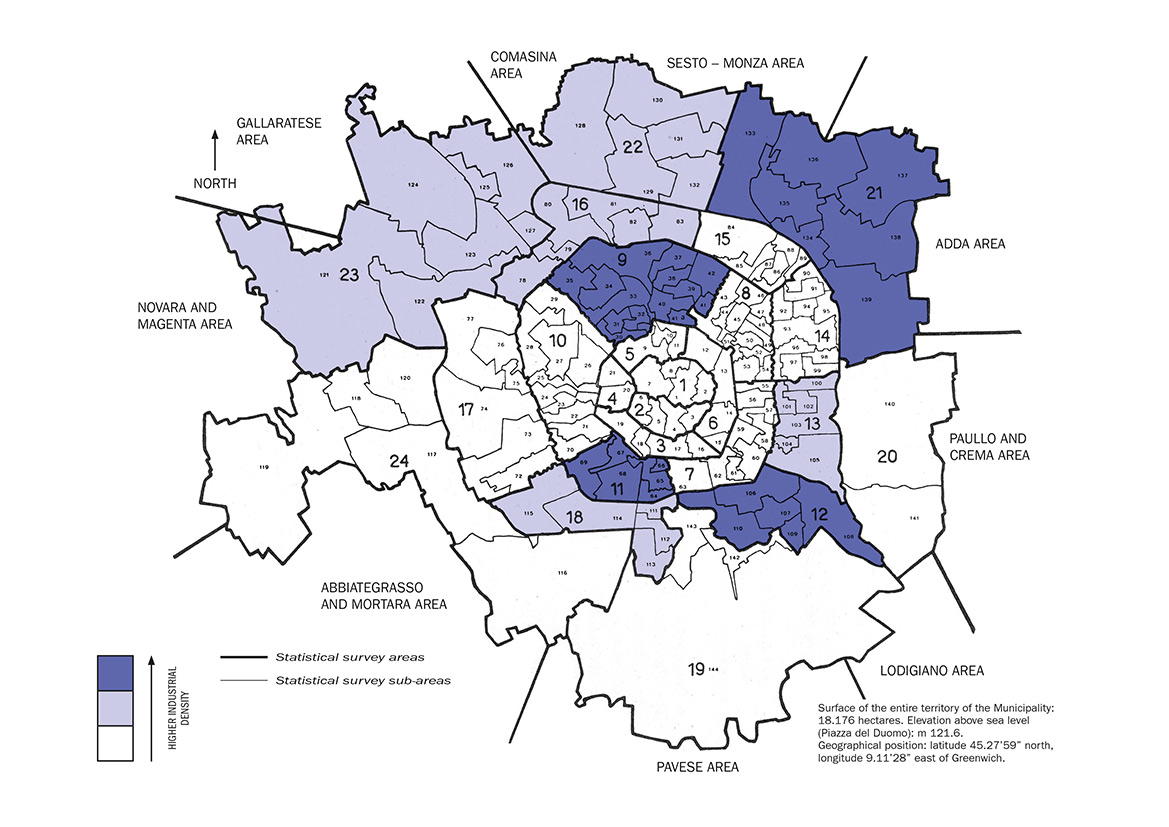
Plan of the Municipality of Milan divided by zone and statistical survey area
Within the Navigli circle
1 – Duomo nord
2 – Duomo sud
From the Navigli circle to the ramparts
3 – Porta Romana-San Vittore
4 – San Vittore-Vincenzo Monti
5 – Parco-Porta Nuova
6 – Porta Nuova-Porta Romana
From the ramparts to the outer ring
7 – Porta Vigentina-Porta Vittoria
8 – Porta Venezia
9 – Porta Garibaldi-Sempione
10 – Porta Magenta
11 – Porta Genova-Porta Ticinese
From the outer ring road to the railway belt
12 – Scalo Porta Romana-Rogoredo
13 – Calvairate
14 – Città Studi
15 – Loreto-Villaggio giornalisti
16 – Dergano-Bovisa-Cagnola
17 – San Siro-Lorenteggio
18 – San Cristoforo-Chiesa Rossa
From the railway belt to the municipal borders
19 – Vigentino-Gratosoglio-Chiaravalle
20 – Rogoredo-Ortica
21 – Lambrate-Crescenzago-Bicocca
22 – Niguarda-Affori-Bruzzano
23 – Quarto Oggiaro-Roserio-Quinto Romano
24 – Baggio-Rocchetto-Barona

The distribution of Milanese industry between the end of the 19th century and the First World WarFor the basic plan the source is Servizio statistica del Comune di Milano (edited), Quaderni di documentazione e studio n.1, Milan 1969, p. 140; for the boundaries of the Corpi Santi the source is Taccola Gregorio (ed.), Cartoguida di Milano. Dai Borghi alla Città, dalla Città ai Quartieri, Touring e Servizi, Milan 2023; the industrial density is the result of data processing by Di Bello Alberto (ed.), I luoghi del lavoro, Ufficio conservazione e valorizzazione raccolte storiche, Milan 2017, pdf
The period between the annexation of Corpi Santi and the First World War: the birth of the industrial periphery
In the decades following the aggregation of Corpi Santi (1873), the growth of the industrial sector drove the growth of the city. The population increase was accompanied by a marked urban expansion. Milan, which had by then largely crossed the boundary of the ring of ramparts, went from 321,839 inhabitants in 1881 to 599,200 in 1911 and 718,800 in 1921. The new city boundaries, however, were not enough to contain the development of the factories, which expanded into the first urban belt of the neighbouring municipalities. This led to the birth of new districts with a strong working-class vocation, such as Bovisa, favoured by the presence of the gasometer and the Ferrovie Nord station. Another industrial area developed between Bicocca and Sesto San Giovanni along the tramway that connected Piazzale Loreto to Brianza, where large companies such as Falck, Ercole Marelli and Edoardo Bianchi emerged. From a housing point of view, between 1906 and 1931, the working class, largely made up of urbanised peasants, populated the former Corpi Santi and the old rural hamlets in the outer ring of the city.
The period between the two world wars
In the years immediately following the end of the First World War and the absorption of the twelve neighbouring municipalities, which created the administrative geography still in force today, a spatial organisation took shape that concentrated services and financial activities in the central core of the city (33% of the city offices were located in the circle of ramparts), in addition to high schools, the Bocconi (1902), Cattolica (1921) and Statale (1924) universities, and the houses of the wealthier social classes. Outside this portion of the city, the civil buildings of the old municipalities that existed before the annexations were characterised by a network of farmsteads, reflecting the semi-rural character and original agricultural vocation of these areas, such as in Affori, Crescenzago, Lambrate and Turro. Also significant in this context is the opening of the new headquarters of the Politecnico di Milano in 1927 in Cascine Doppie (today’s Città Studi), described by Gadda as ‘an expanse of Lambrate meadows’.
In the meantime, with the inauguration of the new Central Station (1931), the suburbs and industry overtook the outer ring planned in the Beruto plan. Manufacturing activities, which in 1936 employed 70% of the workforce, began to move to the peripheries of Milan’s new territorial configuration, where the first public housing estates built by the Istituto Fascista Autonomo per le Case Popolari arose, such as the Lagosta, Regina Elena, Calvairate, Molise and Ponti districts.
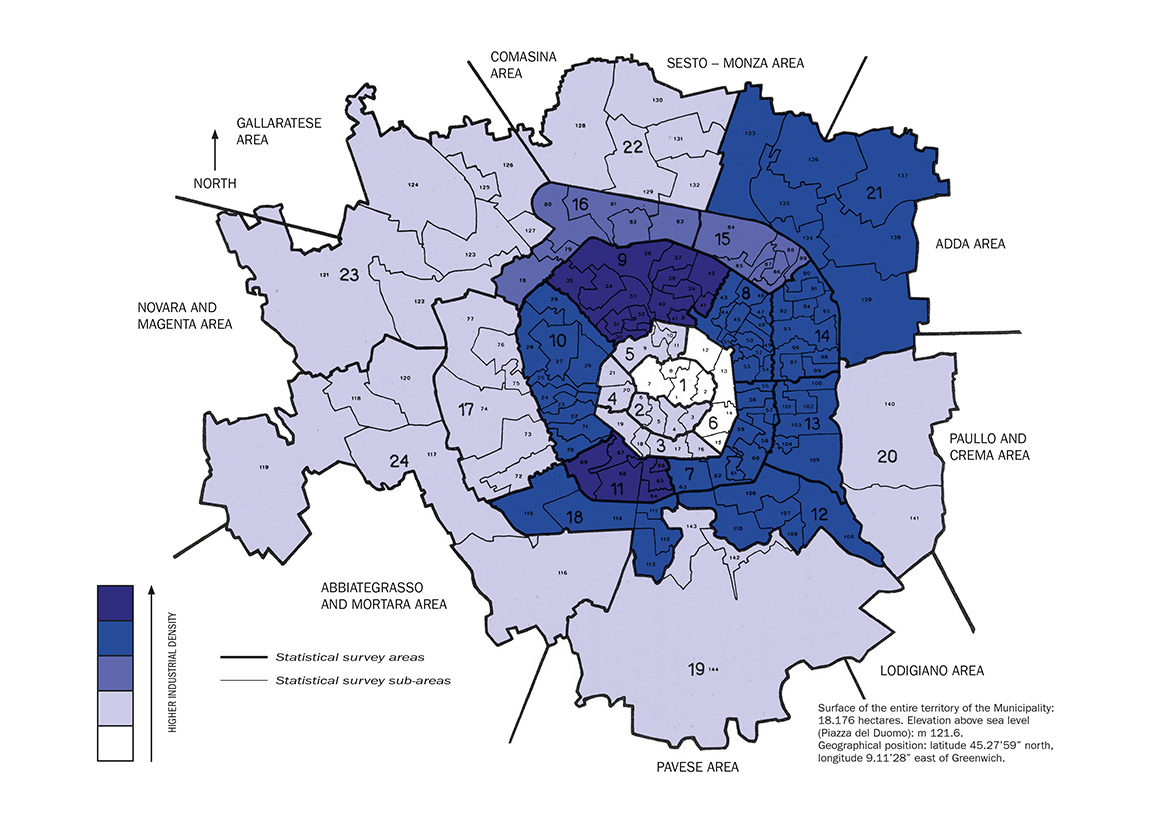
The distribution of Milanese industry between the two world warsFor the basic plan the source is Servizio statistica del Comune di Milano (edited), Quaderni di documentazione e studio n.1, Milan 1969, p. 140; the industrial density is the result of data processing by Di Bello Alberto (ed.), I luoghi del lavoro, Ufficio conservazione e valorizzazione raccolte storiche, Milan 2017, pdf
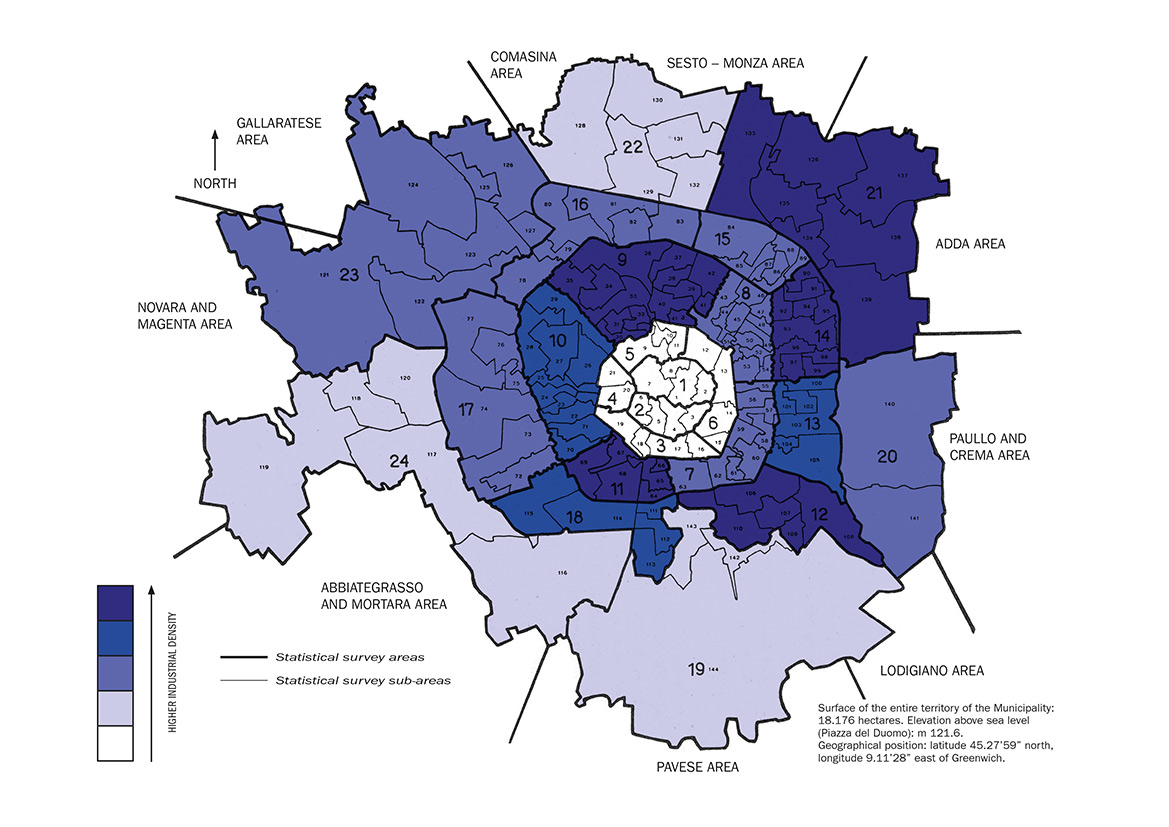
The distribution of Milanese industry in the years of the Reconstruction and the Economic MiracleFor the basic plan the source is Servizio statistica del Comune di Milano (edited), Quaderni di documentazione e studio n.1, Milan 1969, p. 140; the industrial density is the result of data processing by Di Bello Alberto (ed.), I luoghi del lavoro, Ufficio conservazione e valorizzazione raccolte storiche, Milan 2017, pdf
From the Reconstruction to the Economic Miracle
The Second World War, together with the subsequent rise of Milan as the driving force behind the national ‘Economic Miracle’ and industrialisation, accelerated the changes that had already begun in the 1930s: widespread industrialisation took shape without accentuated conflicts between capital and labour; on the contrary, a virtuous interaction emerged between industry and social aggregations such as the trade unions, the red and white cooperative movement and also the solidaristic activity of the Ambrosian Church, led by two outstanding figures such as Idelfonso Schuster and Giovanni Battista Montini. The industrial character of the city faded in the area enclosed by the ramparts and was concentrated in the areas characterised by the presence of one of the city’s numerous freight yards, such as Porta Garibaldi-Sempione (zone 9), Porta Genova-Ticinese (zone 11), Scalo Porta Romana-Rogoredo (zone 12), Città Studi (zone 14) and Lambrate-Crescenzago-Bicocca (zone 21). Since the 1950s, Milan’s economic and urban development has been characterised by the presence of large-scale industry outside the ring of ramparts and the co-presence of small companies in a sub-supply relationship. In this phase, companies that had emerged in the first half of the 20th century were consolidated: in addition to the already mentioned Marelli and Falck, other companies that made the history of Italian industry such as Montecatini, Pirelli, Alfa Romeo, Breda and Recordati. Many industrial settlements that were expanding until the 1970s were then involved in manufacturing transformation processes: Borletti, Carminati Toselli, Carlo Erba, Cartiera Binda, Edoardo Piatti vernici, OM acciaierie, Manifattura Tabacchi, Faema, Innocenti, Istituti cinematografici, Maserati, Dropsa, Fernet Branca, Gondrand, Ansaldo, Mapei, Ceretti Tanfani. From a construction industry point of view, the city centre saw the building of the first skyscrapers (Torre Breda, Torre Velasca, Torre Galfa and Pirellone) while, in the suburbs, the pressure of immigration favoured the emergence of dormitory districts such as Gratosoglio, Quarto Oggiaro-Vialba and Stadera.
From industrial decline to urban regeneration projects
The map of industrial distribution in the years of deindustrialisation clearly shows the decline of Milan’s manufacturing-industrial vocation, now characterised by an economic fabric driven by the service sector. The left-wing juntas, led by the socialists, endorsed this path. Starting in the late 1980s, the debate on the fate of disused former industrial urban areas, including many of the railway freight yards, became intertwined with the political and institutional crisis linked to the Tangentopoli investigations. This period marked a halt in real estate development and a slowdown in infrastructure projects, which would only be resumed after the year 2000. Resources and attention were focused on the reuse and redevelopment of disused industrial areas, including the expansion of the underground network. This process intensified at the beginning of the new millennium, with the approval of urban regeneration projects financed mainly by private capital, often with a significant foreign component, aimed at positioning Milan in the competition among global cities, to attract international investment, tourists and temporary residents. This is the case, for example, in the Garibaldi-Repubblica area, where, thanks to the decisive contribution of American and Middle Eastern capital, the Porta Nuova skyscrapers were built. Significant interventions also affected the southern suburbs, with the construction of the Fondazione Prada headquarters, and the north-western suburbs, where the commercial and residential area of Portello took the place of the Alfa Romeo factories and the City Life district arose in the area vacated by the Fiera Campionaria.